Why AI Agents Need x402
Traditional API billing models are breaking down in the age of autonomous AI. Legacy systems rely on credit cards, API keys, or manual subscription management—mechanisms designed for human users, not software agents. An AI agent needing real-time trading signals cannot pause to fill out a Stripe checkout form or manage a recurring billing cycle. It requires a payment infrastructure that is programmable, instant, and frictionless.
This is where x402 endpoints become essential. Unlike standard HTTP status codes, x402 is a payment protocol designed specifically for machine-to-machine transactions. As defined by the x402 ecosystem, the protocol enables secure, autonomous transactions where agents can pay for services without human intervention. This shifts the paradigm from "user pays" to "agent pays," allowing AI models to purchase data, compute, or signals as a natural part of their execution loop.
The workflow is straightforward and built for speed. When an AI agent hits a paid endpoint, the server returns a 402 Payment Required response containing payment details. The agent then pays in USDC and retries the request with a payment receipt. This process is standardized in x402 V2, which supports multi-chain stablecoins across Base, Solana, and other L2s. For AI trading signals, this means an agent can subscribe to a high-frequency data feed, pay per request, and immediately receive the signal—all within milliseconds.
For developers building AI trading infrastructure, integrating x402 is not just a convenience; it is a necessity for scalability. It removes the friction of onboarding every agent as a unique user, allowing you to monetize your endpoints at a granular, per-call level. This aligns perfectly with the consumption-based nature of AI workloads, where costs and usage fluctuate rapidly based on market conditions and agent activity.
How x402 Handles Trading Payments
When an AI agent calls an endpoint protected by the x402 standard, the interaction begins with a specific HTTP response. Instead of returning data immediately, the server sends a 402 Payment Required status code. This response includes a Pay header that tells the client exactly how much to pay, which blockchain to use, and the destination wallet address. It is the protocol's way of saying, "The data is ready, but the toll is due first."
The client receives the 402 Payment Required status. The response body often contains a preview of the data or a detailed instruction set in the Pay header, specifying the amount in USDC and the required network (e.g., Base or Solana).
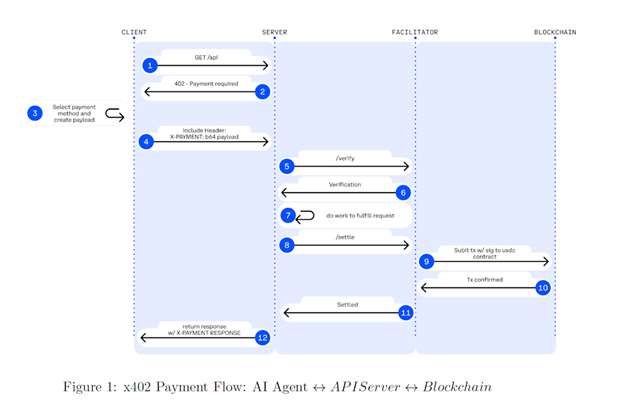
The client initiates a transaction on the specified blockchain. For AI trading signals, this is typically a stablecoin transfer like USDC on Base or Solana. The transaction must match the exact amount and recipient address provided in the 402 response.
Once the transaction is confirmed on-chain, the client resends the request with a proof of payment (usually the transaction hash) in the Authorization header. The server verifies the receipt and returns the trading signal data.
This flow removes the need for API keys or subscription management. The payment is atomic: if the transaction fails or is insufficient, the endpoint remains locked. For AI agents, this means they can autonomously pay for high-frequency trading data without human intervention, treating API calls like any other on-chain transaction.
Infrastructure for Signal Monetization
To turn an AI trading signal into a revenue stream, you need a stack that handles discovery, payment, and execution. The x402 ecosystem isn't a single monolith; it's a collection of specialized infrastructure layers. Choosing the right combination depends on whether you prioritize ease of integration, chain diversity, or agent compatibility.
Coinbase CDP: The Discovery Layer
Coinbase Developer Platform (CDP) provides the "Bazaar," a discovery layer that helps AI agents find x402-enabled services. Instead of hardcoding API endpoints, agents can browse and search for available signals through CDP Facilitator endpoints. This reduces friction for agents that need to dynamically locate high-quality trading data. It’s particularly useful if you want your signal to be discoverable by a wide range of autonomous agents without manual outreach.
Circle: The Payment Rail
For the actual transaction, Circle offers a robust integration with USDC. Their documentation highlights how Circle Wallets enable AI agents to pay APIs autonomously using x402. This is ideal for pay-per-use models where you want instant, on-chain settlement. Circle’s approach focuses on real-time access, ensuring that once a signal is verified, payment is settled immediately without the latency of traditional banking rails or complex smart contract interactions.
Cloudflare: The Execution Edge
Cloudflare serves as the edge infrastructure that routes these requests. While not a payment provider, Cloudflare’s Workers platform can host your x402 endpoint, ensuring low-latency responses for global AI agents. By placing your signal monetization layer at the edge, you reduce the time between a payment confirmation and the delivery of the trading signal. This is critical for time-sensitive market data where milliseconds matter.
Comparison of Infrastructure Providers
The table below compares the core strengths of each provider in the context of x402 implementation. Note that these components often work together rather than in isolation.
| Provider | Primary Role | Key Strength | Best Use Case |
|---|---|---|---|
| Coinbase CDP | Discovery | Agent-friendly search | Making signals discoverable |
| Circle | Payment | USDC integration | Instant on-chain settlement |
| Cloudflare | Execution | Edge computing | Low-latency delivery |
Building the Stack
Most successful x402 implementations combine these layers. You might host your endpoint on Cloudflare Workers, accept payments via Circle’s USDC integration, and list your service on the Coinbase CDP Bazaar. This modular approach allows you to swap out components as the ecosystem evolves. For example, if a new chain becomes dominant, you can adjust the payment rail without changing your discovery or execution logic.
The key is to keep your monetization layer lightweight. AI agents prefer simple, standardized interfaces. By leveraging these established infrastructure providers, you avoid reinventing the wheel and focus on what matters most: delivering accurate, high-value trading signals.
Implement x402 for Trading Data
Turning your AI trading signals into a self-service product requires wrapping your logic in an x402 endpoint. This approach allows AI agents to pay for data automatically, removing friction and enabling micro-transactions that human users rarely tolerate. By standardizing how networks and assets are identified, x402 V2 creates a single payment format that works across chains like Base and Solana without custom logic x402.org.
To get started, you need to structure your API to accept crypto payments directly. An AI agent calling a market data API can pay USDC per request, immediately retrieving liquidity data without human intervention Allium. This means your endpoint must verify the transaction on-chain before returning the signal.
Deploying the Endpoint
Follow this checklist to ensure your trading signal endpoint is production-ready:
-
Define the Price: Set a fixed cost per signal (e.g., 0.01 USDC) or a tiered rate based on data depth.
-
Select the Chain: Choose a low-fee network like Base or Solana to keep micro-transactions viable.
-
Implement Verification: Add middleware that checks for a valid transaction hash before processing the request.
-
Handle Errors: Return clear HTTP errors if payment is missing or the transaction is still pending.
-
Test with Agents: Use a basic AI agent script to simulate a payment and signal retrieval.
This structure ensures your API is not just a data source, but a monetized asset that integrates seamlessly into the agent economy.
Frequently asked: what to check next
What is the x402 V2 protocol?
The x402 V2 standard creates a unified payment format for AI agent transactions. It standardizes how networks and assets are identified, enabling a single interface that works across multiple chains and legacy payment rails. This eliminates the need for custom integration logic for each new asset type.
Which chains does x402 support?
x402 V2 is multi-chain by default. It natively supports stablecoins and tokens across Base, Solana, and other Layer 2 networks. The protocol handles the underlying complexity, allowing your x402 endpoints for AI trading signals to accept payments without maintaining separate wallet integrations for each blockchain.
How do AI agents pay for signals?
Agents use the x402-secure framework to handle pre-payment risk checks transparently. The endpoint verifies the payment token and network before delivering the signal. This ensures that your trading data is only released after the agent has successfully settled the required fee, protecting your revenue stream.
No comments yet. Be the first to share your thoughts!