What x402 means for trading agents
x402 is an HTTP-native payment protocol that revives the HTTP 402 "Payment Required" status code for instant stablecoin payments. Developed by Coinbase, it enables AI agents to make programmatic payments without accounts or credit cards, turning a legacy error code into a functional work primitive [1]. This architecture allows autonomous trading systems to purchase data or signals directly over standard web requests, removing the friction of traditional payment gateways.
For AI trading agents, this protocol is the foundational layer for autonomous commerce. Agents can now pay for high-frequency market data, proprietary signals, or API access using stablecoins directly within the HTTP request lifecycle. The system handles the payment verification as part of the standard response flow, ensuring that only paid requests are fulfilled while maintaining the simplicity of standard web interactions.
The recent launch of x402 V2 expands this capability by standardizing how networks and assets are identified. This update creates a single payment format that works across chains, including Base, Solana, and new L2s, without requiring custom logic for each network [2]. This multi-chain default support ensures that trading agents can access liquidity and data across the broader Web3 ecosystem seamlessly.
To understand the economic context of these transactions, consider the stability of the underlying asset. Stablecoins like USDC are the primary currency for these micro-transactions, maintaining a tight peg to the US dollar.
[1] https://docs.cdp.coinbase.com/x402/welcome [2] https://www.x402.org/writing/x402-v2-launch
Compare x402 infrastructure layers
Building an x402 endpoint requires choosing between three distinct infrastructure models. Each layer handles discovery, settlement, and complexity differently, affecting how AI agents locate and pay for your trading signals.
The Bazaar acts as a centralized discovery layer. It allows agents to browse and search for services cataloged through the Coinbase Developer Platform (CDP) Facilitator. This approach simplifies initial integration but ties your endpoint to a specific ecosystem.
Facilitators provide middleware that handles the heavy lifting of payment routing and receipt verification. They reduce the development burden by abstracting the cryptographic signing and transaction broadcasting required for USDC payments.
Direct endpoints offer the most control. You manage the entire payment flow, from the 402 response to the on-chain settlement. This method is complex but necessary for non-CDP environments or multi-chain requirements.
The table below compares these options based on discovery, settlement, and implementation complexity.
| Layer | Discovery | Settlement | Complexity |
|---|---|---|---|
| Bazaar | Centralized catalog | CDP Facilitator | Low |
| Facilitator | API or manual | Middleware routed | Medium |
| Direct Endpoint | Agent-driven | On-chain direct | High |
Design the signal payment flow
The x402 protocol replaces manual API key management with an automated, stateless request-payment-retry loop. This design allows AI agents to purchase trading signals without pre-funding accounts or maintaining persistent session tokens. The workflow relies on the HTTP 402 status code to signal that payment is required before the endpoint returns data.
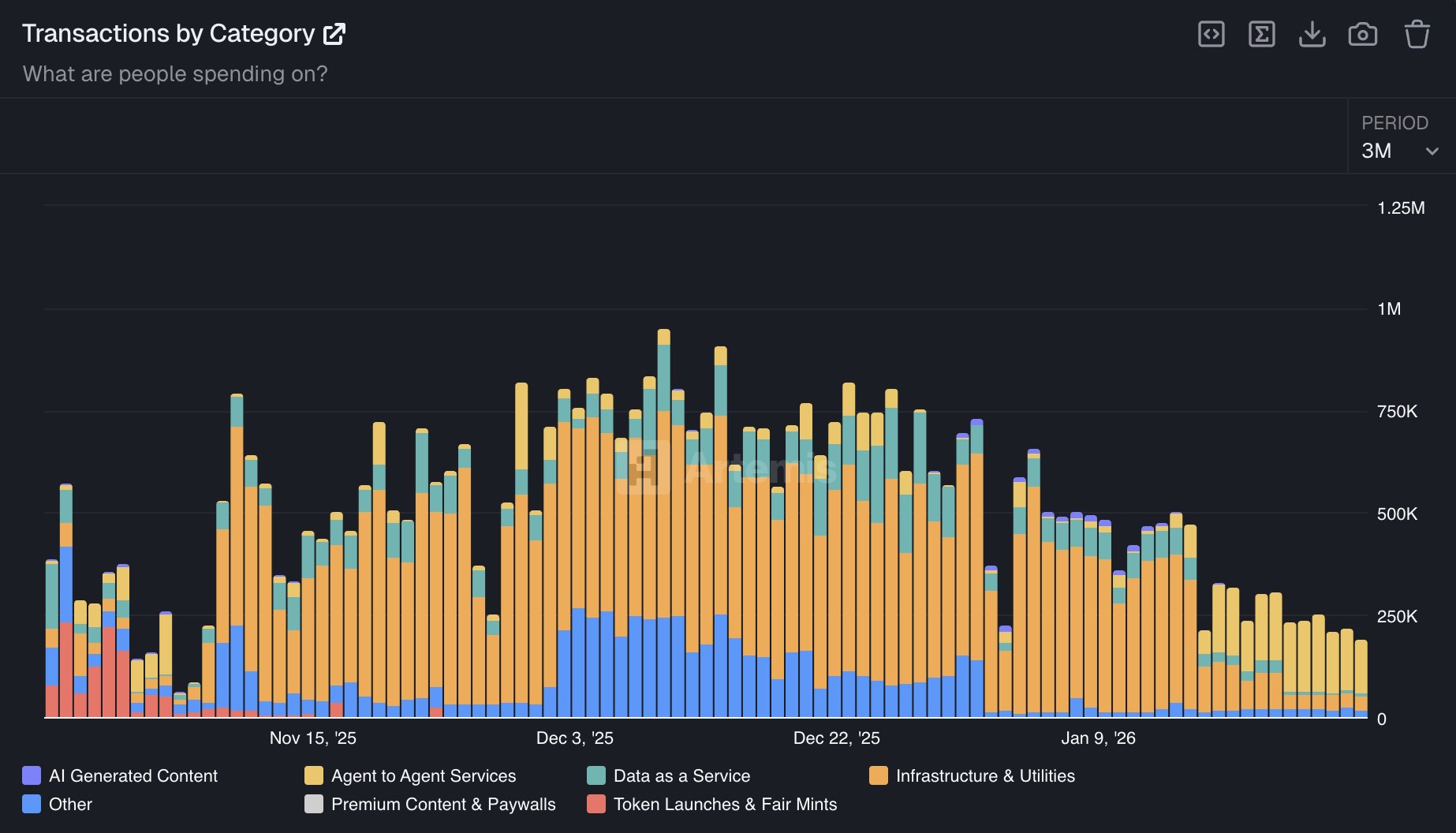
The agent initiates a standard HTTP GET request to the signal provider’s endpoint. At this stage, the request contains no payment credentials. The server processes the request to determine the cost of the signal and prepares the payment instructions, but holds back the actual trading data.
Instead of returning the signal, the server responds with HTTP 402 Payment Required. This response includes a body detailing the payment instructions: the required stablecoin (typically USDC), the exact amount due, the destination wallet address, and a unique invoice ID. This invoice ID is critical for linking the payment to the specific request.
The agent triggers a transaction on the appropriate blockchain using the details from the 402 response. The agent sends the specified amount of USDC to the provider’s wallet. Once the transaction is broadcast, the agent waits for a minimal number of confirmations to ensure the payment is valid on-chain. This step ensures the provider receives real value before the signal is released.

The agent resends the original request, this time attaching the transaction hash or payment receipt as an HTTP header (e.g., x-payment-receipt). This header proves that the payment has been made. The server validates the receipt against its ledger or blockchain explorer to confirm the transaction exists and matches the invoice ID.
Upon successful validation, the server releases the trading signal data. The agent receives the JSON payload containing the buy/sell recommendations, price targets, or market analysis. The entire flow is stateless for the server; it does not need to store user sessions or manage recurring billing, as each signal purchase is a discrete, atomic event.
This architecture ensures that signal providers are paid instantly and agents only pay for data they actually consume. It eliminates the risk of unpaid usage while removing the friction of credit card processing or wallet approvals for every single trade signal.
Choose the right trading strategy
The economics of x402 micropayments shift dramatically depending on how frequently your AI agent requests data. High-frequency trading (HFT) strategies rely on sub-second latency and continuous data streams, while swing trading strategies operate on longer timeframes with fewer, larger requests. The choice of endpoint structure and payment model must align with these distinct operational rhythms to remain profitable.
High-Frequency vs. Swing Trading Economics
HFT agents require real-time order book depth and tick-by-tick price feeds. Because x402 enables instant, automatic stablecoin payments directly over HTTP, agents can pay per-request without friction. However, the volume of requests is immense. If the cost per API call exceeds the marginal profit of a single trade, the strategy fails. In this context, endpoints must be optimized for speed and low overhead, often requiring batched data retrieval to minimize transaction counts while maintaining latency.
Swing trading agents, by contrast, analyze daily or weekly charts to identify entry and exit points. These agents make far fewer requests, perhaps a few hundred per day rather than millions. The economics here favor higher-per-request pricing models, as the cost per call is negligible relative to the potential profit of a swing trade. The primary constraint is not transaction volume but data accuracy and historical depth.
| Strategy | Request Frequency | Preferred Cost Model | Endpoint Priority |
|---|---|---|---|
| High-Frequency | Millions/day | Micro-fee per request | Low latency, batched data |
| Swing Trading | Hundreds/day | Higher fee per request | Historical depth, accuracy |
| Arbitrage | Thousands/minute | Per-scan fee | Cross-chain price feeds |
| Market Making | Continuous | Subscription + micro-fees | Real-time liquidity updates |
Endpoint Structure and Protocol Fit
x402 V2 standardizes how networks and assets are identified, creating a single payment format that works across chains. For HFT, this means your endpoint must handle high-throughput requests on supported chains like Base or Solana without custom logic. The protocol’s HTTP-native nature allows agents to embed payment logic directly in the request, ensuring immediate settlement.
For swing traders, the endpoint can be less optimized for raw throughput and more focused on data integrity. Since requests are less frequent, the overhead of payment verification is less impactful. However, the endpoint must still support x402’s multi-chain capabilities if the agent operates across multiple networks. The key is matching the endpoint’s performance characteristics to the strategy’s request volume and latency requirements.
Decision Framework
When selecting an endpoint, prioritize latency for HFT and data depth for swing trading. Ensure the payment model scales with your request volume. If your agent generates millions of requests, negotiate bulk pricing or use batched endpoints. For lower-frequency strategies, focus on the quality of data and the reliability of the x402 integration. Always test endpoints with real-world traffic patterns before committing to a strategy.
No comments yet. Be the first to share your thoughts!