Why x402 fits trading signals
Traditional API billing relies on credit card charges or subscription tiers that are too slow for the split-second decisions required in algorithmic trading. When an AI agent needs to verify a market signal, it cannot wait for a manual payment approval or a complex OAuth handshake. The x402 protocol solves this by enabling autonomous, per-request payments in USDC, removing friction for AI agents accessing real-time market data.
The x402 V2 standard addresses the fragmentation that plagues cross-chain trading infrastructure. It creates a single payment format that works across Base, Solana, and other chains without requiring custom logic for each network. This neutrality is critical for trading signals, where latency and reliability are the primary metrics of success. By standardizing how networks and assets are identified, x402 allows your signal provider to accept payments from any compatible wallet or agent instantly.
For high-frequency strategies, the difference between a 200-millisecond payment delay and an instant micro-transaction is the difference between profit and slippage. x402-secure integrates pre-payment risk checks transparently, ensuring that your API endpoints are protected from abuse while maintaining the speed necessary for competitive trading environments. This infrastructure shift moves the burden of payment processing from the developer to the protocol, allowing you to focus on signal accuracy rather than billing integration.
How the payment flow works
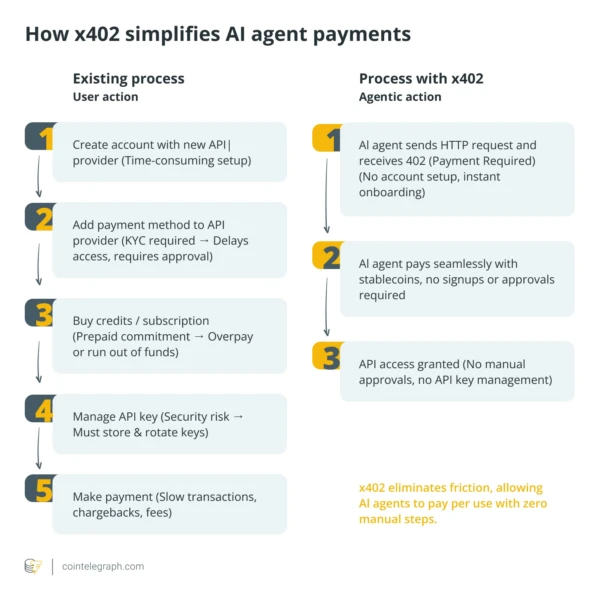
The x402 protocol transforms API endpoints into self-contained payment gateways. Instead of relying on third-party payment processors or manual invoicing, the endpoint itself validates the transaction before delivering data. This architecture allows AI agents to purchase trading signals, market data, or analysis tools with zero human intervention.
At the core of this system is the x-pay header. When an AI agent requests data, it attaches this header containing a signed transaction payload. The server intercepts this request, verifies the cryptographic signature, and checks that the payment meets the required threshold. If the payment is valid, the endpoint returns the requested data immediately. If not, it returns a 402 Payment Required status, blocking access until the debt is settled.
This mechanism is particularly effective for AI trading because it removes the friction of subscription management. Agents can pay per-call or per-token, scaling costs directly with usage. The protocol supports multi-chain stablecoins, primarily USDC, ensuring that transactions are fast, cheap, and compatible across different blockchain networks. This flexibility allows developers to build endpoints that accept payments from any wallet or agent, regardless of the underlying chain.
The flow is standardized across chains, meaning the same codebase can handle payments on Base, Solana, or Ethereum L2s without custom logic. This uniformity reduces development complexity and ensures that buyers and sellers can interact seamlessly. For AI agents, this means they can autonomously manage their data budgets, paying for insights only when they are needed and available.
Step 1: Agent prepares the request
The AI agent identifies the endpoint it needs to query and retrieves the required payment parameters from the endpoint's documentation. It then constructs a transaction payload containing the necessary token amount and chain details. This payload is signed using the agent's private key, ensuring that the transaction is authentic and cannot be tampered with. The agent attaches the x-pay header to the HTTP request, embedding the signed payload.
The AI agent identifies the endpoint it needs to query and retrieves the required payment parameters from the endpoint's documentation. It then constructs a transaction payload containing the necessary token amount and chain details. This payload is signed using the agent's private key, ensuring that the transaction is authentic and cannot be tampered with. The agent attaches the x-pay header to the HTTP request, embedding the signed payload.
Step 2: Server validates the payment
Upon receiving the request, the server extracts the x-pay header and verifies the cryptographic signature. It checks the transaction against the blockchain to ensure that the funds have been sent and confirmed. The server also validates that the payment amount meets the minimum threshold set by the endpoint. If the signature is invalid, the amount is insufficient, or the transaction is unconfirmed, the server rejects the request.
Upon receiving the request, the server extracts the x-pay header and verifies the cryptographic signature. It checks the transaction against the blockchain to ensure that the funds have been sent and confirmed. The server also validates that the payment amount meets the minimum threshold set by the endpoint. If the signature is invalid, the amount is insufficient, or the transaction is unconfirmed, the server rejects the request.
Step 3: Data is delivered
Once the payment is verified, the server processes the request as if it were a standard API call. It executes the necessary logic to generate the trading signal or retrieve the market data. The response is then sent back to the agent, completing the transaction. The agent can now use the data to inform its trading strategy, with the cost of the data already settled on the blockchain.
Once the payment is verified, the server processes the request as if it were a standard API call. It executes the necessary logic to generate the trading signal or retrieve the market data. The response is then sent back to the agent, completing the transaction. The agent can now use the data to inform its trading strategy, with the cost of the data already settled on the blockchain.
Step 4: Reconciliation and logging
The server logs the transaction details, including the agent's wallet address, the amount paid, and the timestamp. This record is stored for auditing and reconciliation purposes. The seller can use this data to track revenue, monitor usage patterns, and manage their API resources. The agent also receives a confirmation of the successful transaction, allowing it to update its internal budget and track spending.

The server logs the transaction details, including the agent's wallet address, the amount paid, and the timestamp. This record is stored for auditing and reconciliation purposes. The seller can use this data to track revenue, monitor usage patterns, and manage their API resources. The agent also receives a confirmation of the successful transaction, allowing it to update its internal budget and track spending.
Step 5: Multi-chain compatibility
The x402 protocol is designed to work across multiple blockchains, allowing sellers to accept payments in various stablecoins and tokens. This compatibility ensures that agents can pay using the assets they already hold, without the need for complex conversions. The protocol handles the differences between chains, such as transaction fees and confirmation times, providing a unified experience for both buyers and sellers.

The x402 protocol is designed to work across multiple blockchains, allowing sellers to accept payments in various stablecoins and tokens. This compatibility ensures that agents can pay using the assets they already hold, without the need for complex conversions. The protocol handles the differences between chains, such as transaction fees and confirmation times, providing a unified experience for both buyers and sellers.
Step 6: Automated budget management
AI agents can integrate x402 into their internal budget management systems, allowing them to autonomously manage their data spending. Agents can set limits on how much they are willing to pay for specific types of data, ensuring that they do not overspend. This automation enables agents to operate continuously, purchasing data as needed without human oversight.
AI agents can integrate x402 into their internal budget management systems, allowing them to autonomously manage their data spending. Agents can set limits on how much they are willing to pay for specific types of data, ensuring that they do not overspend. This automation enables agents to operate continuously, purchasing data as needed without human oversight.
Step 7: Secure and transparent
All transactions are recorded on the blockchain, providing a transparent and immutable record of payments. This transparency builds trust between buyers and sellers, as both parties can verify the history of transactions. The use of cryptographic signatures ensures that only authorized agents can access paid endpoints, preventing unauthorized use and fraud.
All transactions are recorded on the blockchain, providing a transparent and immutable record of payments. This transparency builds trust between buyers and sellers, as both parties can verify the history of transactions. The use of cryptographic signatures ensures that only authorized agents can access paid endpoints, preventing unauthorized use and fraud.
- Always verify the
x-payheader signature before processing any request. - Set clear payment thresholds to prevent unauthorized access to your endpoints.
- Use stablecoins like USDC to minimize volatility risk for both buyers and sellers.
- Log all transactions for auditing and reconciliation purposes.
- Test your endpoints with multiple chains to ensure broad compatibility.
Building the Seller Infrastructure
Setting up an x402 endpoint requires more than just adding a payment button to your API. You need a wallet capable of receiving payments and a server configuration that understands the 402 Payment Required status code. For signal sellers, this infrastructure is the bridge between providing data and getting paid for it.
Wallet and Payment Setup
The foundation is a compatible crypto wallet. Coinbase Developer Platform (CDP) offers a straightforward path for sellers, providing tools to manage keys and receive funds securely. You can start by following their quickstart guide to integrate with x402, which walks you through the necessary API connections.
For those focused on stablecoin transactions, Circle Wallets offer a robust solution for USDC payments. This integration allows AI agents to pay for your signals autonomously, enabling real-time, pay-per-use access without manual intervention. This is particularly useful for high-frequency trading signals where latency matters.
Endpoint Configuration
Your API endpoint must be configured to handle the x402 protocol. When a request comes in, your server should check for valid payment credentials. If payment is missing or invalid, you return a 402 Payment Required response. This tells the client—whether a human trader or an AI agent—that payment is needed to access the resource.
The x402 V2 standard simplifies this by standardizing how networks and assets are identified. It creates a single payment format that works across chains, including Base, Solana, and various L2s. This means you don't need custom logic for each blockchain; the protocol handles the complexity.
Multi-Chain Support
Supporting multiple chains is no longer a luxury; it's a requirement for broad adoption. x402 V2 is multi-chain by default, supporting stablecoins and tokens across different networks. This flexibility allows your signal service to accept payments in USDC on Ethereum, Solana, or other supported chains without additional development effort.
By leveraging these standards, you reduce the friction for buyers. They can pay using their preferred wallet and chain, while you receive payments in a consistent, stable format. This setup ensures that your monetization strategy is scalable and future-proof.
Choosing the right x402 tools
Selecting the right infrastructure depends on which chains your AI agents will use and how much boilerplate you want to handle. x402 V2 has standardized how networks and assets are identified, creating a single payment format that works across chains and with legacy payment rails [src-1]. This means you no longer need custom logic for every new L2 or chain you want to support.
When evaluating providers, look for SDKs that simplify wallet generation and payment verification. The goal is to let your agent pay USDC per request and immediately retrieve data without human intervention [src-0]. A good tool should handle the cryptographic signatures and chain-specific transaction details so you can focus on the signal logic.
The table below compares popular facilitators based on their supported chains and integration complexity. Use this to quickly identify which stack fits your current architecture.
| Provider | Supported Chains | Ease of Integration | Documentation |
|---|---|---|---|
| Allium | Base, Solana, L2s | SDK-based | Official Blog |
| x402.org | Multi-chain | Standard Protocol | Official Spec |
| Community SDKs | Varies | Variable | GitHub/Reddit |
Start with the official x402 documentation to understand the base standard. Then, test the SDK with a small budget to ensure the payment flow works as expected before scaling your agent's capabilities.
Common questions about x402
What is the x402 V2 protocol?
x402 V2 standardizes how networks and assets are identified, creating a single payment format that works across chains and with legacy payment rails. It is multi-chain by default, supporting stablecoins and tokens across Base, Solana, and other L2s without requiring custom logic. Learn more about the V2 launch.
What is the x402 ecosystem?
x402 is an open, neutral standard for internet-native payments. It absolves the Internet's original sin by natively making payments possible between clients and servers, creating win-win economies that empower agentic payments at scale. The ecosystem is designed to be neutral and open, allowing developers to build without vendor lock-in. Explore the x402 ecosystem.
How does x402 handle AI agent risk?
The x402-secure standard is specifically designed for transactions involving autonomous AI agents. It transparently integrates pre-payment AI agent risk checks, ensuring that payments are only released when the agent has successfully fulfilled its task. This adds a layer of trust and security for both the payer and the service provider.
Is x402 only for AI agents?
While x402 is particularly well-suited for AI agents due to its machine-readable nature, it is not limited to them. Any client-server interaction that requires automated, programmatic payments can leverage the protocol. This includes microtransactions, API usage fees, and data streaming services.
No comments yet. Be the first to share your thoughts!