Why AI trading needs native payments
Traditional payment rails like Stripe or PayPal were built for human shoppers, not autonomous software. They require manual authorization, handle disputes through friction-heavy chargebacks, and operate on batch settlement cycles that are too slow for high-frequency trading. When an AI agent needs to purchase real-time market data or execute a micro-transaction, waiting for a human to approve a credit card charge breaks the automation loop entirely.
The infrastructure gap is critical for AI trading agents that operate at machine speed. An agent calling a market data API needs to pay USDC per request and immediately retrieve liquidity data to act on it. If the payment fails or requires manual review, the trading opportunity vanishes. x402 solves this by treating payment as a native part of the HTTP transaction, not a separate, external process.
This shift from "human-approved" to "machine-native" payments is what makes autonomous trading viable. By standardizing how payments are handled across APIs, x402 allows agents to interact with financial data providers as seamlessly as they interact with each other. This isn't just about convenience; it's about enabling the infrastructure that allows AI to trade at the speed of the market it monitors.
How the x402 payment flow works
The x402 protocol transforms the standard HTTP 402 "Payment Required" status code into a programmable payment gateway. Unlike traditional web payments that require human interaction, x402 allows AI agents to negotiate, pay, and receive data entirely through code. This mechanism is essential for the autonomous economy, where agents must purchase trading signals or data feeds without human approval.
When an AI agent requests a paid endpoint, the server responds with an HTTP 402 status code. This response includes a JSON body containing the payment details: the exact amount due, the accepted stablecoin (usually USDC), the target blockchain network, and the destination wallet address. The agent parses this challenge to understand the cost of the data.
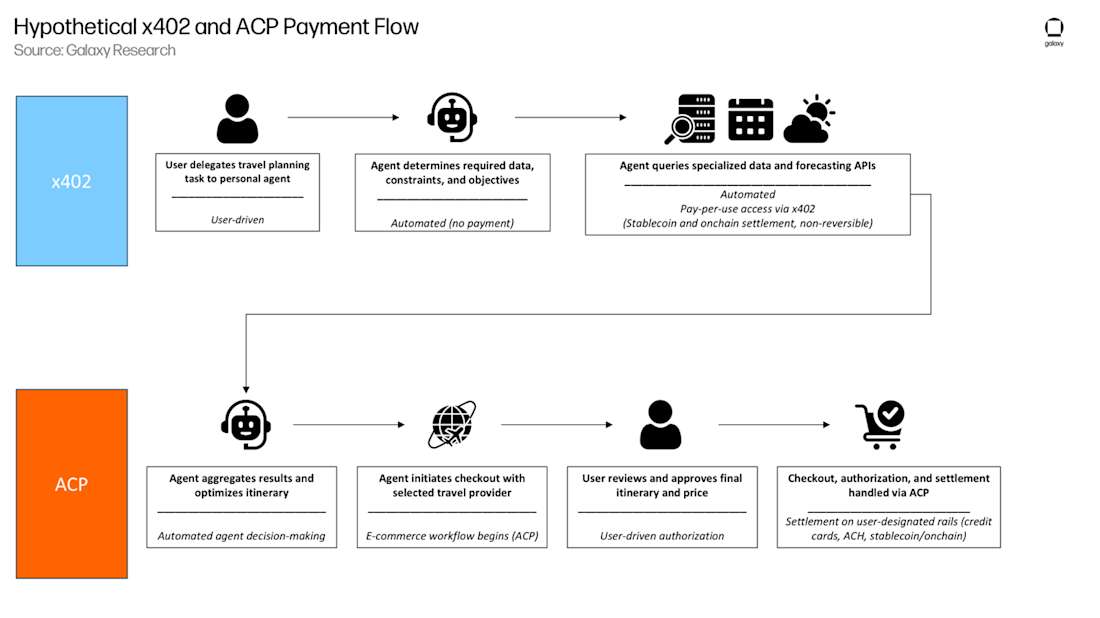
The agent constructs a transaction to send the specified amount of USDC to the provided wallet address. This step occurs on-chain, typically on networks like Base or Ethereum, where stablecoin transactions are fast and cheap. The agent waits for the transaction to be confirmed by the network, ensuring the payment is irreversible and verifiable.
Once the transaction is confirmed, the agent generates a payment receipt containing the transaction hash and proof of payment. The agent resubmits the original request, attaching this receipt in the headers. The server verifies the transaction hash on-chain to ensure the payment was actually made to the correct address.
Upon successful validation of the receipt, the server grants access to the endpoint. The agent receives the requested trading signals or data payload. If the payment fails or the receipt is invalid, the server returns a 402 error again, allowing the agent to retry or abort the operation.
This flow ensures that data providers are compensated instantly and automatically. For AI agents, it removes the friction of manual payments, enabling high-frequency trading strategies that rely on real-time, paid data sources. The protocol’s reliance on standard HTTP means it integrates seamlessly with existing API infrastructure, making it a robust solution for machine-to-machine commerce.
Building the x402 Trading Stack
To deploy AI trading signals as paid x402 endpoints, you need a stack that handles high-frequency requests, instant settlement, and secure discovery. The architecture relies on three core components: the Coinbase Developer Platform (CDP) for the payment rail, Cloudflare Workers for edge execution, and the x402 Bazaar for service discovery.
This setup shifts the burden of payment handling from your application logic to the protocol layer. Instead of managing API keys or subscription databases, your endpoint simply returns a 402 Payment Required status with payment instructions when an agent requests a signal. The agent pays in USDC, receives a receipt, and retries the request to get the data.
| Feature | Traditional API | x402 Endpoint |
|---|---|---|
| Payment Model | Subscription or tiered access | Per-request, pay-as-you-go |
| Settlement | Net-30 or monthly billing | Instant on-chain settlement |
| Discovery | Manual listing or private keys | Automated via x402 Bazaar |
| Identity | API keys or OAuth | Cryptographic wallet signatures |
Cloudflare Workers for Edge Execution
Cloudflare Workers provide the compute layer for your x402 endpoints. Because they run at the edge, they offer the low latency required for real-time trading signals. You can write your signal generation logic in JavaScript or TypeScript, and deploy it globally with minimal cold starts.
The worker acts as the gatekeeper. It intercepts incoming HTTP requests, checks for the x402 payment receipt in the headers, and processes the trade signal if payment is verified. If payment is missing, it returns the 402 response with the necessary payment details, including the recipient address and amount in USDC.
Coinbase Developer Platform Integration
The CDP provides the infrastructure for handling the USDC payments and verifying receipts. You don't need to build your own wallet management or transaction monitoring systems. The CDP Facilitator helps you register your endpoint and manage the payment flow.
When an agent pays, the CDP verifies the transaction on the blockchain (typically Base or Ethereum L2) and ensures the funds are transferred to your wallet. This verification is crucial for maintaining the integrity of your trading service, as it prevents unauthorized access without requiring complex manual reconciliation.
The x402 Bazaar for Discovery
The x402 Bazaar serves as the discovery layer for your endpoint. It allows AI agents to browse and search for x402-enabled services that are cataloged through the CDP Facilitator. This is essential for finding buyers for your trading signals without manual marketing.
By registering your endpoint in the Bazaar, you make it visible to agents that are programmed to search for specific types of data or signals. This creates a marketplace where supply and demand can meet automatically, driven by the protocol's standardization of payment and discovery.
Market Context
The adoption of x402 is growing as AI agents become more autonomous. The ability to pay for data instantly and securely is a key feature for high-frequency trading environments. Monitor the USDC price to understand the value of your signals in real-time.
Designing Signal-Specific x402 Endpoints
Structuring an x402 endpoint for AI trading requires treating data as a utility rather than a feature. Unlike traditional APIs that rely on user authentication and monthly subscriptions, x402 enables machine-to-machine commerce where the API call itself triggers a micro-transaction. For high-frequency trading agents, this shifts the infrastructure burden from identity management to payment verification. The agent must verify the x-payments header contains a valid transaction receipt before returning signal data, ensuring that every tick or signal update is monetized instantly.
Pricing Models for Micro-Transactions
The most effective pricing structures for trading signals align with data consumption. Per-tick pricing works best for real-time order book data, where agents pay only for the specific updates they process. For broader market signals, such as sentiment analysis or technical indicators, a per-signal fee prevents agents from polling endpoints unnecessarily. You can also implement subscription bundles using recurring receipts, allowing agents to pre-fund accounts for high-volume periods. This approach reduces the latency of individual payment verifications while maintaining a steady revenue stream.
Data Granularity and Rate Limiting
Data granularity should match the pricing tier. High-frequency agents require millisecond-level updates, which justifies higher per-tick costs. Lower-tier agents might receive aggregated data at slower intervals. To protect your infrastructure, implement strict rate limiting based on payment verification. Agents that fail to provide valid receipts or exceed their allocated transaction limits should receive immediate HTTP 402 responses. This ensures that your endpoints remain responsive for paying customers and prevents resource exhaustion from unpaid requests.
Verification and Error Handling
Proper error handling is critical for autonomous agents. When a payment is missing or invalid, return a clear 402 Payment Required status with a link to your payment endpoint. This allows agents to automatically retry with valid credentials. For successful requests, include the transaction hash in the response headers for auditability. This transparency helps trading bots reconcile their expenses and ensures that your service remains compliant with x402 standards.
x402 V2 and multi-chain support
The original x402 specification laid the groundwork for machine-to-machine payments, but x402 V2 expands the protocol’s reach beyond Ethereum’s ecosystem. By standardizing how networks and assets are identified, V2 creates a single payment format that works across multiple blockchains without requiring custom integration logic for each one.
This multi-chain capability is critical for AI trading signal providers. While Base remains a popular settlement layer for high-frequency microtransactions, V2 explicitly supports stablecoins and tokens on Solana, other EVM-compatible chains, and emerging L2s. This means a signal provider can accept payments in USDC on Base, Solana, or Arbitrum using the same HTTP endpoint structure.
For trading infrastructure, this flexibility reduces friction. Providers no longer need to maintain separate payment gateways for different chains. Instead, they can route payments through the most cost-effective or liquid chain for their specific user base, ensuring that the payment mechanism never becomes a bottleneck for signal delivery.
Launch checklist for x402 endpoints
Before sending live trading signals, verify your endpoint handles the x402 payment protocol correctly. This checklist ensures your API is discoverable, compliant, and ready for agent commerce.
List your service in the Coinbase Developer Platform (CDP) Bazaar. This discovery layer allows AI agents to find and authenticate your x402-enabled endpoints automatically.

Ensure your API returns a 402 Payment Required status with a valid Authorization challenge when payment is missing. The response must include the necessary metadata for the client to construct the payment.

Use USDC on Base to simulate real-world transactions. Verify that your endpoint processes the payment token correctly and unlocks the trading signal data only after successful confirmation.

Host your endpoint on a low-latency edge network. Ensure your CORS policies and rate limits are configured to handle automated agent traffic without blocking legitimate requests.
No comments yet. Be the first to share your thoughts!