Why agents need x402 endpoints
Current AI agent payment models are built for human users, not autonomous code. Traditional payment gateways require pre-funded wallets, complex API key management, and rigid subscription logic. This friction breaks high-frequency trading workflows where an agent might need to purchase hundreds of micro-signals per second. The agent cannot pause to enter a credit card number or manage a balance across multiple exchanges.
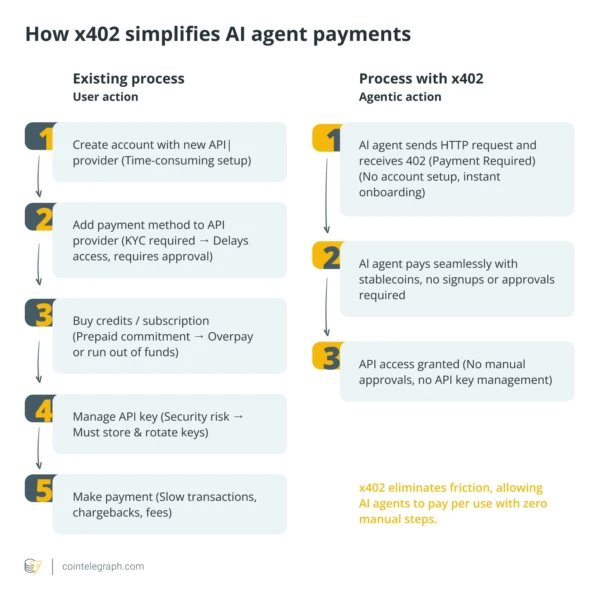
The x402 protocol solves this by standardizing HTTP-level payments. When an AI agent requests a trading signal, the server responds with a 402 Payment Required status code containing payment instructions. The agent pays in USDC via smart contract and retries the request automatically. This creates a seamless, machine-to-machine economy where payment and data delivery happen in a single atomic transaction x402.org.
For trading agents, this means access to real-time data without the overhead of maintaining persistent payment channels. The protocol handles risk checks and transparent pre-payment validation, allowing agents to operate at scale without manual intervention Digital Applied.
This shift from human-mediated billing to machine-native payments unlocks new possibilities for AI-driven market strategies. Agents can now purchase data on demand, paying only for the signals they actually use. This efficiency is critical for high-frequency trading, where latency and cost directly impact profitability.
How x402 handles trading data payments
The x402 protocol solves the friction of paying for AI trading signals by embedding payment directly into the HTTP layer. Instead of managing API keys, subscriptions, or off-chain invoices, the endpoint communicates cost and accepts payment in a single exchange. This approach, often called "machine-to-machine" commerce, allows agents to request data and settle fees without human intervention.
1. The 402 Payment Required Response
When an AI agent or client requests a trading signal endpoint, the server evaluates the request against its pricing rules. If the request lacks a valid payment signature or proof of settlement, the server responds with an HTTP 402 Payment Required status code. This is not an error; it is a standard HTTP signal defined in RFC 9110, specifically reserved for payment scenarios. The response body typically includes a Pay header or a JSON payload detailing the amount, the accepted currency (usually a stablecoin like USDC), and the destination wallet address.
2. On-Chain Settlement
Upon receiving the 402 response, the client’s payment agent constructs a transaction. For AI trading, speed and low cost are critical, so most x402 implementations use Layer 2 networks like Base or Solana. The agent signs a transaction transferring the exact amount of USDC to the provider’s address. This step replaces traditional credit card processing or wallet whitelisting. The transaction must be confirmed on-chain, which on fast L2s often takes less than a second. The x402 V2 standard simplifies this by standardizing how networks and assets are identified, allowing a single payment format across chains without custom logic for each provider.
3. Verifying Payment and Retrieving Data
Once the transaction is confirmed, the client generates a cryptographic proof of payment. This proof is included in the Authorization header of a new request to the same endpoint. The server verifies the blockchain state to ensure the payment was genuine and not a replay attack. If the proof is valid, the server responds with 200 OK and delivers the requested trading signal data. This closed loop ensures that only paying clients access the data, creating a sustainable economic model for AI signal providers.
The client sends an initial HTTP GET request to the trading endpoint. No authentication header is needed yet, as the server will determine if payment is required.
The server returns a 402 Payment Required status. The response body contains the Pay header with the amount (e.g., 0.05 USDC) and the destination address on the Base network.
The client’s agent signs a USDC transaction on the specified L2. This step is automated and typically completes in under two seconds on networks like Base.
The agent attaches the transaction hash or proof to a new request. The server verifies the on-chain confirmation and returns the trading data with a 200 OK status.
The Infrastructure Behind x402 Endpoints
Deploying x402 endpoints for AI trading signals requires understanding three core components: the Facilitator, the Bazaar, and the underlying blockchain networks. Together, these layers create a neutral, automated payment rail that allows AI agents to buy and sell data without human intervention.
The Facilitator and Bazaar
The Facilitator acts as the central registry for x402-enabled services. It catalogs endpoints, verifying that they adhere to the protocol’s payment standards. For signal providers, registering with the Facilitator is the first step in making your data discoverable.
The Bazaar serves as the discovery layer. Built on top of the Facilitator, it allows AI agents to search, browse, and identify available x402 services. When an agent needs real-time market data, it queries the Bazaar, finds a compatible endpoint, and initiates a payment. This process is entirely autonomous, removing the friction of manual API key management or subscription billing.
Supported Chains and Settlement
x402 is designed to be chain-agnostic, but it relies on specific networks for instant settlement. The protocol supports stablecoins and tokens across Base, Solana, and other L2s, creating a unified payment format that works across different ecosystems. This multi-chain approach ensures that trading signals can be paid for in USDC or other stable assets, regardless of where the agent or provider operates.
The result is a streamlined flow: the agent identifies the service via the Bazaar, pays via the Facilitator’s registry, and receives the data instantly on-chain. This structure absolves the internet’s original sin of paymentless interactions, creating a win-win economy for data providers and AI agents alike.
Payment Flow Comparison
| Feature | Traditional API Billing | x402 Endpoint Payments |
|---|---|---|
| Identity | API Keys / OAuth | Public Key / DID |
| Payment | Monthly Subscription (Stripe) | Per-Request (USDC/Stablecoin) |
| Settlement | Net-30 / Net-60 | Instant on-chain |
| Agent Access | Manual Setup | Autonomous Discovery & Pay |
This comparison highlights why x402 is uniquely suited for AI trading signals. The per-request model aligns costs with usage, while instant settlement ensures providers are paid immediately for the liquidity data they deliver.
Implementing x402 for live signals
Turning AI trading signals into a paid product requires more than just a smart contract; it requires a payment layer that agents understand natively. By implementing x402 endpoints, you allow autonomous agents to pay for data without human intervention or traditional API keys.
The protocol standardizes network and asset identification, creating a single payment format that works across chains like Base and Solana. This means your trading signal endpoint can accept payments in stablecoins or native tokens without custom logic for each chain. The x402 ecosystem is designed to be neutral and open, removing the friction of legacy payment rails.
Set up the endpoint
Start by configuring your API to return a 402 Payment Required status code when no valid payment is provided. This is the core mechanic of the protocol. The response must include a payment-params header that details the required asset, the network, and the amount. For trading signals, this amount should reflect the value of the data, such as a per-call fee for real-time market data.
Configure asset and network
Define which assets your endpoint accepts. Most AI agents prefer stablecoins for predictable costs, but supporting native tokens can lower transaction fees for smaller payments. Ensure your endpoint validates the transaction on-chain before returning the signal data. This verification step prevents fraud and ensures the agent has actually paid for the request.
Test with an agent client
Use a test agent or a simple script to simulate the payment flow. Send a request to your endpoint without payment to verify the 402 response. Then, use a wallet connected to your agent to sign and send the payment. Once the transaction is confirmed, the agent should receive the trading signal data automatically. This end-to-end test confirms your implementation works for autonomous commerce.
x402 V2 and multi-chain support
The x402 V2 upgrade transforms the protocol from a single-chain experiment into a universal standard for AI trading signals. By standardizing how networks and assets are identified, V2 creates a single payment format that works across blockchains and legacy rails without requiring custom integration logic.
This multi-chain architecture is essential for traders who operate across different ecosystems. Whether your AI agent needs to pay for signals on Base, Solana, or emerging L2s, V2 handles the complexity natively. You can now use stablecoins or native tokens seamlessly, ensuring that payment friction never interrupts your trading strategy.
The result is a unified payment layer that treats the internet like a true economy. As noted in the official x402 documentation, this approach absolves the "original sin" of the web by natively enabling payments between clients and servers. For AI agents, this means they can now autonomously purchase high-value trading data regardless of where the liquidity lives.
Common questions about x402 signals
The x402 Endpoints for AI Trading Signals guide focuses on how autonomous agents handle payments, but the underlying protocol mechanics often raise specific questions. Understanding the version history and ecosystem scope helps clarify why x402 is distinct from traditional payment gateways.
No comments yet. Be the first to share your thoughts!