What x402 enables for signal providers
x402 is an open standard for internet-native payments that allows AI agents to pay APIs directly in stablecoins like USDC without traditional billing infrastructure. This protocol removes the friction of manual invoicing and credit card processing, creating a seamless economy where software can transact with software. For signal providers, this means unlocking a new tier of liquidity from autonomous agents that operate 24/7 across global markets.
Before x402, an AI agent calling a market data API had to rely on human-mediated subscriptions or complex wallet management. Now, an agent can pay USDC per request, immediately retrieving liquidity data without human intervention. This micro-transaction capability is critical for trading signals, which are often consumed in high-frequency bursts rather than steady streams. Providers can now charge per signal, per minute, or per data packet, aligning cost directly with value received.
The x402 V2 standard further simplifies this by standardizing how networks and assets are identified. It creates a single payment format that works across chains and with legacy payment rails. This multi-chain support means signal providers aren't locked into a single blockchain ecosystem. Whether a trader uses Base, Solana, or an Ethereum L2, the payment infrastructure remains consistent, reducing integration barriers and expanding the potential addressable market for specialized trading insights.
How the payment flow works
x402 endpoints for AI trading signals turn the HTTP request itself into a payment instrument. Instead of waiting for a manual invoice or managing off-chain subscriptions, the agent attaches a payment header to its request. The server validates this header against the blockchain before returning any data. This mechanism creates a trustless, programmatic loop where payment and data delivery happen simultaneously.

The AI agent constructs an HTTP request to the endpoint. It includes an x-payment header containing a signed transaction payload. This payload specifies the asset, amount, and the blockchain network where the payment will settle. The agent does not wait for confirmation before sending; it simply attaches the proof of intent to pay.
The server receives the request and extracts the transaction ID from the header. It queries the relevant blockchain node or indexer to verify that the transaction exists and meets the required criteria (e.g., sufficient value, correct recipient address, and confirmation depth). If the transaction is invalid or missing, the server rejects the request with an HTTP 402 error.
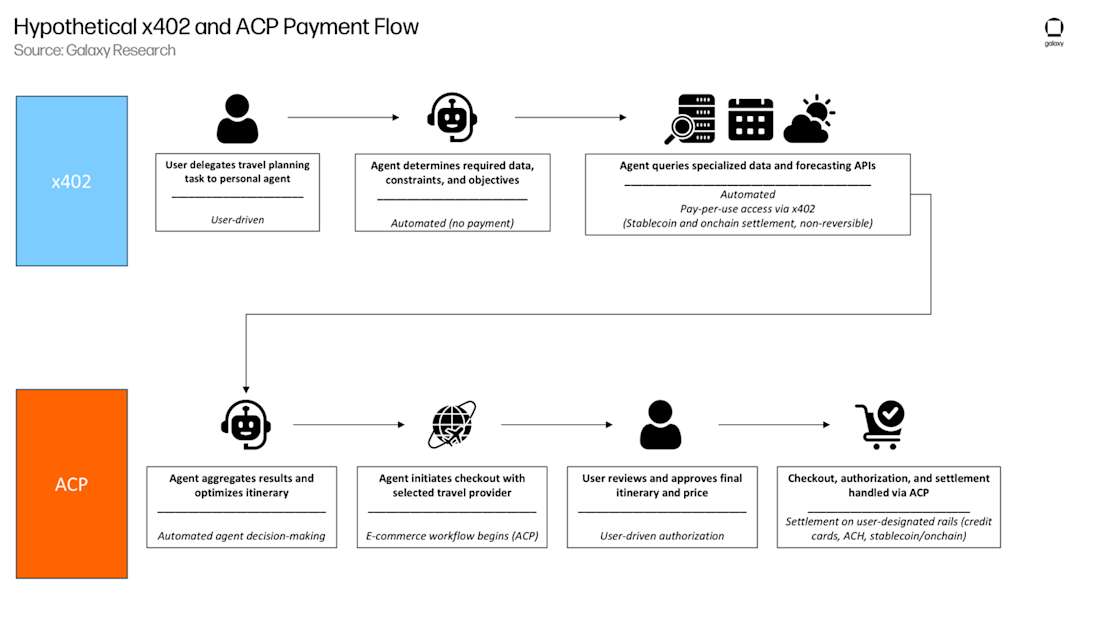
Once the server confirms the onchain transaction is valid, it immediately processes the request and returns the AI trading signal in the response body. The entire process happens in the context of a single HTTP call, enabling high-frequency, micro-transaction workflows without latency from separate payment gateways.
This flow eliminates the need for third-party payment processors or wallet connections. The x402 standard abstracts the complexity of blockchain interactions, allowing agents to pay for data using native tokens or stablecoins. As noted in the official documentation, this approach enables programmatic, HTTP-native payments that settle in seconds with near-zero fees.
x402 V2 vs traditional API billing
The shift from legacy credit card processing to x402 V2 represents a structural upgrade in how AI agents interact with data. Traditional API billing relies on centralized payment processors like Stripe to manage recurring subscriptions or prepaid credits. This model requires agents to maintain long-lived auth tokens and handle complex retry logic when a card expires or a transaction declines. The result is a brittle system where an agent's ability to fetch trading signals can stall due to payment friction.
x402 V2 introduces a unified payment format that operates natively across multiple blockchains. Instead of relying on a single payment gateway, x402 V2 standardizes how networks and assets are identified, allowing AI agents to use stablecoins like USDC for instant, on-chain settlement. This creates a system where payment and data delivery are tightly coupled, removing the need for external billing portals.
The following table contrasts the operational mechanics of both approaches, highlighting the differences in settlement speed, cross-chain compatibility, and agent autonomy.
| Feature | x402 V2 Standard | Traditional API Billing |
|---|---|---|
| Settlement Time | Near-instant (on-chain) | Days (bank clearing) |
| Cross-Chain Support | Multi-chain (Base, Solana, L2s) | Single rail (credit card) |
| Agent Autonomy | High (self-sovereign wallets) | Low (third-party gateways) |
| Fee Structure | Pay-per-use (microtransactions) | Subscription or batched credits |
For AI trading signals, this distinction is critical. A legacy billing system treats payments as a separate administrative layer, often introducing latency that degrades the value of time-sensitive market data. In contrast, x402 V2 enables "autonomous payments," where an agent can pay for a signal and receive the data in a single atomic step. This autonomy allows agents to operate 24/7 without manual intervention for payment renewal or error handling. The standardization of payment formats across chains also means that a single agent can access signals from providers on Base, Solana, or other L2s without needing to manage multiple payment integrations.
While traditional billing offers familiarity and chargeback protection for human users, it introduces unnecessary complexity for autonomous software. The x402 V2 model prioritizes speed and interoperability, ensuring that the cost of data access does not become a bottleneck for AI-driven trading strategies.
Infrastructure for signal monetization
To turn an AI trading model into a revenue stream, you need to assemble three distinct layers. The first layer is the wallet, which holds the funds and signs transactions. The second is the facilitator, a middleware service that handles discovery and routing. The third is the discovery layer, often called Bazaar, where buyers find your endpoint. Without these components, your signals remain invisible to autonomous agents.
Wallets and Stablecoin Payments
Your endpoint needs a wallet capable of receiving USDC. While any compatible EVM wallet works, using a managed wallet service like Coinbase Developer Platform (CDP) simplifies key management and reduces operational overhead. The payments flow in USDC because it is the standard stablecoin for x402 transactions, providing price stability for both the signal provider and the buyer. This eliminates the volatility risk that would otherwise make automated, high-frequency trading signal purchases impractical.
The Facilitator Layer
The facilitator acts as the bridge between your endpoint and the broader network. It validates the x402 protocol compliance and ensures that payments are correctly routed to your wallet. By offloading this complexity to a facilitator, you avoid building custom infrastructure for payment verification. The facilitator also indexes your service, making it discoverable to AI agents that are scanning for reliable data sources.
Discovery via Bazaar
Bazaar serves as the primary discovery layer for x402-enabled services. It allows AI agents to browse and search for endpoints based on specific criteria, such as asset type or signal latency. When an agent finds your endpoint in Bazaar, it can automatically test the API and initiate payments. This discovery mechanism is critical for scaling your signal business, as it connects your supply of data with the demand from autonomous trading agents.
Deployment strategy for x402 endpoints
Your x402 endpoint for AI trading signals can go live in three distinct ways, each with different tradeoffs for speed, cost, and control. The right path depends on whether you prioritize rapid market entry or long-term infrastructure independence.
Build a custom endpoint
Building your own endpoint gives you full control over the payment flow and signal delivery. You handle the x-payments header parsing, wallet management, and signal routing directly. This approach is ideal if you have specific compliance requirements or need to integrate with proprietary trading engines. However, it requires significant engineering effort to secure the endpoint and manage on-chain transactions.
Use a facilitator
Facilitators like Eco provide a middleware layer that handles the complex x402 protocol details. You simply expose your signal API, and the facilitator manages the payment verification and wallet interactions. This reduces your development time significantly and lets you focus on signal quality rather than payment infrastructure. It is the best choice for teams that want to launch quickly without building custom payment logic.
Join a discovery marketplace
Platforms like CDP Bazaar allow you to list your AI trading signals alongside other data providers. This strategy is best for discovery and user acquisition, as buyers can find your endpoint through the marketplace’s search and filtering tools. While it simplifies customer acquisition, you may face revenue sharing or platform dependency risks. Use this if your primary goal is visibility rather than building a standalone brand.
-
Test payment headers with a testnet wallet
-
Verify wallet balance and gas limits
-
Integrate facilitator SDK if chosen
-
Set up monitoring for failed payments
Frequently asked questions about x402
What are x402 tokens?
x402 is an open, neutral standard for internet-native payments. It removes the need for third-party payment processors by making payments possible directly between clients and servers. This creates a win-win economy that empowers agentic payments at scale, allowing AI agents to pay for API access seamlessly.
What is the x402 V2 protocol?
x402 V2 standardizes how networks and assets are identified, creating a single payment format that works across chains and with legacy payment rails. Key upgrades include multi-chain support by default, allowing stablecoins and tokens across Base, Solana, other chains, and new L2s without requiring custom logic.
How does x402 compare to traditional payment gateways?
Traditional gateways introduce high fees and latency due to intermediary banks and processors. x402 enables programmatic, HTTP-native payments that drop fees to near zero and settle in approximately one second. This makes it significantly more efficient for high-frequency AI trading signals where speed and cost are critical.
Is x402 only for crypto traders?
While it is built for crypto, x402 is an open standard that can integrate with legacy payment rails. It allows businesses to accept payments in both cryptocurrency and fiat-equivalent stablecoins. This flexibility makes it suitable for any service requiring automated, machine-to-machine transactions, not just trading.
No comments yet. Be the first to share your thoughts!