Why AI agents need native payments
AI trading agents operate at speeds and volumes that human oversight cannot match. When an agent scans market data, it needs to execute thousands of API calls per second to gather liquidity, order book depth, and price feeds. Traditional payment gateways—designed for human checkout flows with credit cards or bank transfers—introduce latency, friction, and authentication hurdles that break this autonomous loop. An agent cannot pause to enter a CVV code or approve a transaction in a pop-up window.
To access high-value trading data, agents require a payment layer that is as machine-to-machine as the data itself. This is where x402 changes the infrastructure. As an open, internet-native payment protocol built on the HTTP 402 status code, x402 allows any API to require payment before serving content. The Coinbase Development Platform team developed this standard to solve the "internet's original sin": the lack of native payments between clients and servers.
With x402, an AI agent calling a market data API can pay USDC per request and immediately retrieve liquidity data without human intervention. The protocol handles the transaction, verifies the payment, and grants access in a single, automated step. This frictionless model enables a new economy where AI agents can autonomously purchase real-time insights, scaling their operations without manual financial oversight.
The x402 payment flow
When an AI agent requests a trading signal from an x402 endpoint, the server doesn't just return data. It returns a 402 status code. This HTTP response includes a payment URI, typically for USDC, and the specific instructions needed to complete the transaction. The agent must pay before it can access the proprietary data.
1. The agent requests the endpoint
The process begins when the agent sends a standard HTTP request to the API endpoint. The server recognizes the request requires payment and prepares a 402 response. This response contains the payment details, including the amount, currency, and the wallet address or smart contract interaction required.
2. The server returns payment details
The server responds with a 402 status code. This is not an error, but a specific instruction. The response body includes a payment URI, often in the format crypto:.... It tells the agent exactly how much to pay and to whom. This step is critical because it establishes the terms of the exchange before any value changes hands.
3. The agent pays in USDC
The agent's internal wallet processes the payment. Using the payment URI from the server, the agent signs and broadcasts a transaction to the blockchain. Most x402 implementations use stablecoins like USDC for speed and predictability. The transaction must be confirmed on-chain, which typically takes a few seconds to minutes depending on the network.
4. The agent retries with proof
Once the transaction is confirmed, the agent retries the original request. This time, it includes a proof of payment in the headers or as part of the request body. This proof is usually a transaction hash or a signed message that the server can verify against the blockchain. The server checks the proof to ensure the payment was successful and matches the requested amount.
5. The server delivers the signal
After verifying the proof of payment, the server processes the request. It generates the trading signal based on the latest market data and returns the result in the response body. The agent receives the signal and can now use it for execution. The entire flow, from request to signal delivery, happens automatically without human intervention.
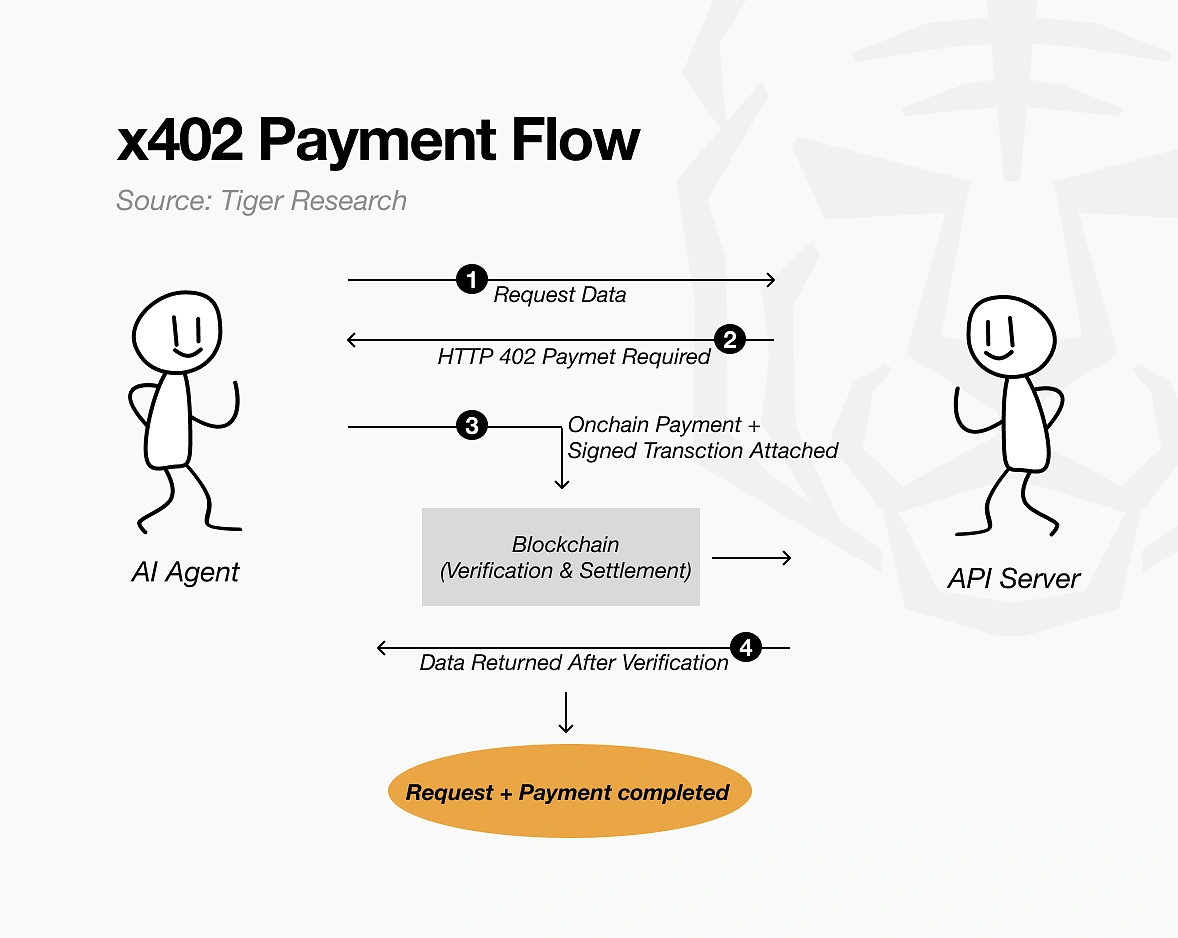
The agent sends an HTTP request to the API. The server recognizes the need for payment and prepares a 402 response with payment instructions.
The server returns a 402 status code with a payment URI. This URI includes the amount, currency, and wallet address for the transaction.
The agent's wallet processes the payment using the provided URI. The transaction is broadcast to the blockchain and must be confirmed.
The agent retries the request, including a proof of payment in the headers. The server verifies the transaction hash against the blockchain.
Once payment is verified, the server delivers the trading signal. The agent receives the data and can proceed with execution.
Wrapping Trading Logic with x402 Middleware
Integrating x402 into a signal provider’s infrastructure is less about rewriting your trading engine and more about placing a payment gatekeeper at the door. The goal is to ensure that market data—whether it’s a real-time price feed or a complex signal calculation—is only served after payment is verified. This creates a frictionless commerce layer for AI agents that can pay on-chain without needing traditional credit cards or complex KYC processes.
The Middleware Pattern
The most robust way to implement this is through a middleware layer that intercepts incoming API requests before they reach your core trading logic. When an agent requests a signal, the middleware checks for the Payment-Required (402) header.
If the payment is missing or invalid, the server returns a 402 status code along with a Payment-Mechanism header. This header tells the client exactly how to pay—specifying the URI, the token, and the amount. Once the agent pays the on-chain invoice, it sends the payment proof back in the next request. Only then does the middleware allow the request to proceed to your trading algorithm.
This pattern keeps your core trading logic clean and agnostic to payment methods. You simply focus on the signal generation, while the middleware handles the commerce.
Visualizing the Protected Data
The data being protected is often volatile and time-sensitive. The following chart illustrates the kind of market activity that signal providers often package and sell. Securing this data ensures that only paying agents receive the edge.
Handling Multi-Chain Payments
x402 V2 simplifies the complexity of multi-chain payments. Instead of maintaining separate payment endpoints for Ethereum, Solana, or Base, the protocol standardizes how networks and assets are identified. This means your middleware can accept payments in various stablecoins or tokens across different chains without custom logic for each.
For example, an agent might pay in USDC on Base, while another pays in ETH on Ethereum. The middleware validates the proof against the specified network and token, then releases the data. This flexibility is crucial for AI agents that operate across multiple blockchain ecosystems simultaneously.
Security and Verification
Security is paramount when dealing with financial data. Always verify payment proofs on-chain before serving sensitive signals. Relying on off-chain confirmation alone is risky, as it can be spoofed. By checking the transaction hash against the blockchain, you ensure that the payment is final and irreversible.
This approach not only secures your revenue but also builds trust with your clients. Agents know that their payments are secure and that the data they receive is genuine. As the x402 protocol continues to evolve, integrating these standards will become essential for any serious AI trading signal provider.
Handling multi-chain settlements
The biggest friction point for AI agents isn't generating the signal; it's getting paid for it. Traditional payment gateways force developers to build custom logic for every new blockchain they want to support. x402 V2 removes that burden by treating payments as a protocol-level standard rather than an app-specific feature. This means your trading signal endpoint can accept payments on Base, Solana, or any emerging L2 without rewriting the checkout code.
By standardizing how networks and assets are identified, x402 V2 creates a single payment format that works across chains and legacy rails. For signal providers, this translates directly into liquidity. You no longer need to maintain separate wallets or reconcile balances across five different chains. The agent pays, the protocol routes it, and the liquidity stays within the network where the signal was requested.
Here is how x402 V2 compares to traditional single-chain or fiat-only gateways when handling AI agent commerce:
| Feature | x402 V2 Protocol | Traditional Gateway | Single-Chain Only |
|---|---|---|---|
| Cross-Chain Support | Native (Base, Solana, L2s) | None (Fiat only) | One chain only |
| Custom Logic Required | None | High (Integration) | Medium (Routing) |
| Agent Compatibility | Full HTTP 402 | API/Webhook | Partial |
| Settlement Speed | Near-instant | 1-3 days | Instant |
Verifying agent payments securely
When an AI trading agent returns a 200 OK with signal data, the first step is not to execute the trade, but to validate the payment proof attached to the response. x402 relies on this cryptographic attachment to ensure that the service provider actually received the settlement before releasing proprietary intelligence. Without this check, you risk paying for signals that were never delivered or, worse, falling for a spoofed response from a malicious endpoint.
The payment proof is typically embedded in the response headers or the JSON payload as a signed transaction receipt. You must verify that the signature matches the agent’s public key and that the transaction hash corresponds to a confirmed state on the blockchain. This is not just a formality; it is the core security layer that prevents double-spending and ensures the agent’s economic incentives are aligned with your safety. As noted by the x402 ecosystem, this verification step is specifically designed to handle the risks inherent in autonomous agent transactions by making pre-payment checks transparent and immutable.
If the proof is missing, malformed, or fails signature verification, treat the response as invalid. Do not trust the signal data, regardless of how confident the agent’s text appears. In the world of agentic commerce, the payment proof is the only reliable indicator that the contract has been fulfilled. Always implement a local validator that rejects any response without a verifiable x402 payment token, ensuring your trading infrastructure only acts on settled, authenticated data.
Common x402 integration: what to check next
We get a lot of technical questions about how x402 actually works under the hood, especially when integrating it with high-frequency AI trading signals. Here are the answers to the most frequent queries we see from developers building agentic payment infrastructure.
For more details on the protocol specifications, check the official x402 documentation.
No comments yet. Be the first to share your thoughts!