Why trading data needs agent payments
Autonomous AI agents operate at speeds and volumes that human operators cannot match. When an agent needs real-time market data to execute a trade, it cannot pause to wait for a monthly invoice, negotiate a credit line, or manually enter credit card details. Traditional API billing models rely on friction-heavy administrative overhead that breaks down the moment automation enters the loop.
The current standard for API access involves static API keys and manual billing cycles. This works for a human developer making ten calls a day, but it fails for an AI agent processing thousands of requests per second. An agent cannot "approve" a charge or resolve a billing dispute. If the payment method expires or the invoice goes unpaid, the agent is locked out, causing missed market opportunities or failed trades.
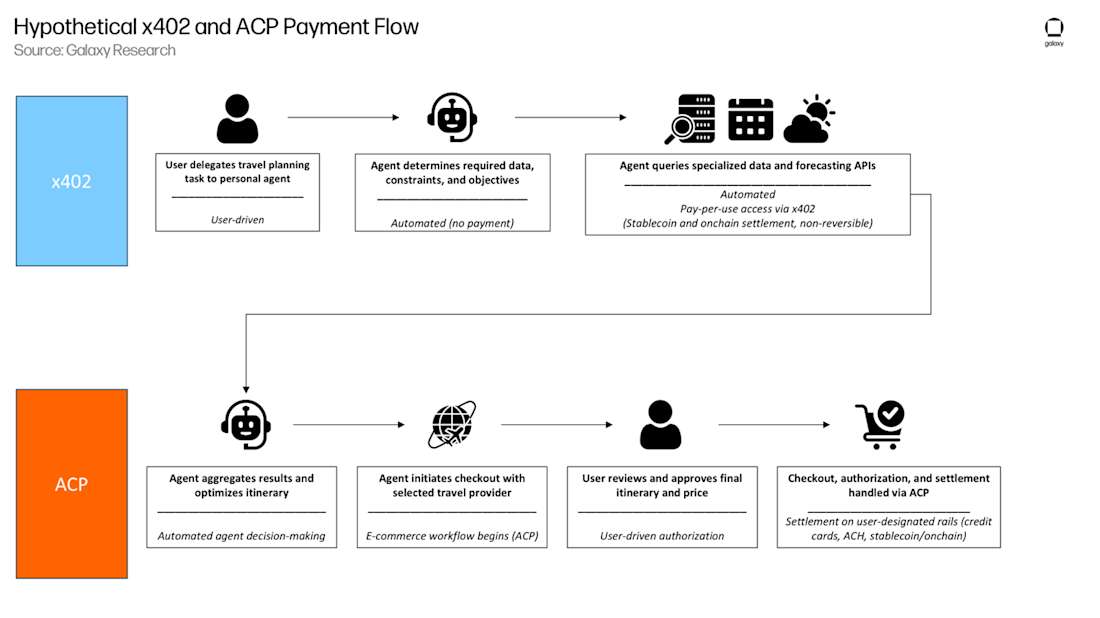
x402 solves this by embedding payment directly into the HTTP protocol. Instead of a separate billing layer, the agent pays with stablecoins like USDC per request, instantly retrieving the data it needs. This turns data access into a frictionless, machine-to-machine transaction. The agent pays, the endpoint returns the data, and the loop continues without human intervention.
For trading signals, this means your endpoint becomes a self-sustaining revenue stream. You do not need to chase payments or manage subscriptions for individual agents. Each request is a micro-transaction, settled in real-time. This model aligns perfectly with the high-frequency, low-latency nature of algorithmic trading, where every millisecond of delay costs money.
How x402 secures trading endpoints
The HTTP 402 status code acts as a digital tollbooth for AI agents. When an AI model requests a trading signal, the endpoint returns a 402 Payment Required response instead of the data. This response includes a specific payment URI, forcing the agent to settle the transaction before accessing the endpoint. This mechanism shifts the power dynamic from data theft to verified payment, ensuring that signal providers are compensated before any proprietary logic is exposed.
Settlement happens on-chain, creating an immutable record of the transaction. The AI agent must hold the required stablecoin balance in a compatible wallet and sign a transaction to the provided address. Once the blockchain confirms the payment, the endpoint releases the signal data. This on-chain verification eliminates the need for trusted third-party escrow services, reducing latency and counterparty risk for both the provider and the AI agent.
Risk checks are embedded directly into the payment flow. The x402 protocol allows providers to define pre-payment conditions, such as minimum wallet balances or reputation scores, before the agent can even attempt to pay. This prevents low-effort scraping bots from flooding endpoints with failed requests. By filtering out non-compliant agents at the protocol level, providers protect their infrastructure from abuse while ensuring that only serious, funded agents access their signals.
The volatility of the underlying assets adds another layer of context. Signal providers often price their endpoints in stablecoins to avoid exchange rate risk, but the AI agent’s funding source might be a volatile asset like Bitcoin. Understanding the current market price helps providers set appropriate fees that account for potential slippage during the settlement window.
This combination of status-code enforcement, on-chain settlement, and pre-payment risk checks creates a secure environment for AI-driven trading. It transforms the endpoint from a vulnerable data source into a verified, monetized service that protects providers from fraud while enabling seamless, automated transactions for AI agents.
Setting up the signal infrastructure
Integrating the x402 protocol into your trading API endpoints requires shifting from traditional authentication to a payment-first workflow. Instead of relying solely on API keys, your endpoint must validate a cryptographic signature that proves the requestor has paid for the signal data. This setup ensures that high-value AI trading signals are protected and monetized directly at the HTTP layer.
1. Define your signal schema and pricing
Before writing code, determine the structure of the data you are selling. Will you provide raw JSON signal objects, or a structured summary with entry, exit, and stop-loss levels? You must also set a clear price per request. For high-frequency trading signals, micro-transactions in stablecoins are standard. Define the exact cost in USD or the equivalent stablecoin amount (e.g., USDC) that your endpoint expects for each valid response.
2. Implement the 402 handler
Your server needs to intercept incoming requests and check for the Authorization header. According to the x402 specification, this header contains the signed transaction data. If the signature is missing or invalid, return a 402 Payment Required status code with a Signature-Input header that tells the client how to sign the request. This step is critical for preventing unauthorized access to your proprietary algorithms.
3. Verify the cryptographic signature
Once a client sends a signed request, your backend must verify the signature against the sender's public key. This ensures the request hasn't been tampered with and that the payment was actually broadcast to the blockchain. Use a library compatible with the Coinbase Developer Platform (CDP) to validate the x402 signature. Only proceed to process the signal logic if the signature is valid and the transaction is confirmed on the chosen chain.
4. Connect the wallet and return the signal
After verification, process the trading signal and return the data in your predefined schema. Ensure your endpoint is robust enough to handle network latency from the blockchain verification process. For AI agents, the response must be immediate and machine-readable. This completes the loop: payment is secured, the signal is delivered, and the infrastructure is ready for production use.
Structure your JSON response and set a micro-payment price in stablecoins for each signal request.
Intercept requests and return 402 status codes with Signature-Input headers if payment is missing.
Validate the x402 signature using CDP-compatible libraries to ensure the payment is authentic and confirmed.

Process the verified request and return the trading signal data immediately to the AI agent client.
Choosing the right payment rails
Selecting the correct blockchain and stablecoin for x402 endpoints determines whether your AI trading signals arrive in milliseconds or minutes. Because x402 V2 standardizes how networks and assets are identified, you can use a single payment format across multiple chains without writing custom logic. This flexibility is essential for high-frequency trading agents that cannot afford network congestion or unpredictable gas spikes.
USDC remains the primary settlement currency for these micro-transactions due to its deep liquidity and predictable peg. The live price widget above confirms the stability required for automated agent wallets. When an AI agent requests a signal, the payment must settle instantly to release the data stream. Any delay in confirmation can cause the trading window to close before the signal is received.
| Chain | Avg. Latency | Avg. Cost | Agent Compatibility |
|---|---|---|---|
| Base | < 1s | <$0.01 | High (EVM-native) |
| Solana | ~400ms | <$0.001 | High (Non-EVM) |
| Ethereum | 12-15s | $0.10+ | Medium (High gas) |
| Arbitrum | < 1s | <$0.01 | High (EVM-native) |
Base and Solana offer the lowest latency and costs, making them ideal for high-volume signal delivery. Base provides EVM compatibility, allowing you to reuse existing smart contract infrastructure. Solana offers sub-second finality, which is critical for arbitrage or scalping strategies. Ethereum mainnet is generally too slow and expensive for micro-payments unless the signal value is exceptionally high. Arbitrum serves as a strong middle ground for EVM-based agents requiring faster throughput than Ethereum L1.
For most trading bots, starting with Base or Solana provides the best balance of speed and cost. Use the x402 discovery layer to verify that your signal provider accepts payments on your chosen rail. This ensures seamless integration without manual reconciliation or delayed settlements.
Common integration mistakes to avoid
Building x402 endpoints for AI trading signals requires strict adherence to the protocol. The most frequent error is exposing endpoints without proper 402 validation. If your API accepts requests without verifying the HTTP 402 status code or the accompanying payment proof, autonomous agents cannot verify the transaction. This leaves your system vulnerable to free usage or, worse, manipulation by bad actors attempting to spoof payment headers.
Another critical pitfall is ignoring V2 protocol updates. The x402 V2 standard, developed by the Coinbase Developer Platform, introduces multi-chain support and a unified payment format across Base, Solana, and other networks. Integrating with an outdated V1 implementation means your trading signals may fail to process payments on newer chains or legacy rails. Always check the official x402 documentation to ensure your endpoint handles the latest asset identifiers and chain-specific logic.
Finally, avoid treating x402 as a simple payment gateway. It is a security layer for AI agents. Ensure your endpoint validates the x-payments header and rejects malformed requests before executing any trading logic. This prevents resource exhaustion and ensures that only verified, paid-for signals are delivered to your users.
No comments yet. Be the first to share your thoughts!