Why x402 fits agent trading
AI agents need frictionless, programmatic payment methods to access real-time trading data without human intervention. Traditional payment gateways require account creation, manual approval, or complex API keys that break the autonomous loop. When an agent detects a market signal, it shouldn't pause to ask for credit card confirmation; it should execute the trade immediately.
x402 solves this by integrating payments directly into the HTTP protocol. Instead of separate billing flows, the response to an API request includes a x-payment-required header. The agent pays with stablecoins in the same transaction that retrieves the data. This creates a seamless, machine-to-machine economy where access is granted only upon payment.
This approach eliminates the latency and security risks associated with storing sensitive payment information. For trading signals, where milliseconds matter, x402 ensures that data access is instantaneous and auditable on-chain. The agent pays only for what it consumes, making it ideal for high-frequency, low-margin strategies.
By removing the human from the payment loop, x402 enables truly autonomous trading agents. They can subscribe to premium data feeds, pay per query, and execute trades based on the results—all without human oversight. This is the foundation for scalable, self-sustaining AI trading systems.
The x402 payment flow explained
When an AI agent requests a trading signal from an x402-compliant endpoint, the interaction follows a strict, automated handshake. The server does not accept the initial request as-is. Instead, it signals that payment is required before the data is released. This mechanism ensures that the agent pays for access in real-time, using on-chain stablecoins like USDC.
1. The server returns a 402 response
The process begins when your agent sends an HTTP request to the endpoint. If the endpoint requires payment, the server responds with an HTTP status code of 402 Payment Required. This is not an error in the traditional sense; it is a directive. The response body contains the payment details your agent needs to proceed. These details typically include:
- The cryptocurrency amount due (e.g., 0.01 USDC).
- The destination wallet address.
- The specific blockchain network (e.g., Base, Ethereum).
- Expiration time for the payment proof.
Your agent must parse this JSON payload to understand exactly what to pay and where.
2. The agent executes the on-chain payment
Once the agent has the payment parameters, it constructs a transaction. Using its connected wallet, it sends the specified amount of USDC to the provided address on the designated blockchain. This step happens entirely on-chain, meaning the payment is immutable and verifiable by anyone. The agent waits for the transaction to be confirmed on the network. This confirmation is critical because the payment proof is tied to the transaction hash.
3. The agent retries with a signed proof
After the payment is confirmed, the agent does not simply send the request again. It must attach a cryptographic proof of payment to the request headers. This proof is a signed message that links the original request to the on-chain transaction. The server verifies this signature against the blockchain data. If the proof is valid and the payment is sufficient, the server processes the request and returns the trading signal data. If the proof is invalid or missing, the server returns a 402 again, and the cycle repeats.
This automated loop allows AI agents to access paid data sources without human intervention. The strict requirement for on-chain proof ensures that the server receives payment before delivering sensitive or valuable trading signals. This creates a trustless environment where the agent and the server can interact securely.
Building the endpoint infrastructure
To make your AI trading signals accessible via x402, you need to shift from traditional API key authentication to a payment-per-request model. This requires setting up a server that validates on-chain payments before returning sensitive data.
1. Return 402 Status Codes
Your endpoint must recognize when a request lacks valid payment. When an AI agent or user calls your trading signal API without a valid Paywalled-Request header, return a 402 Payment Required status. Include the payment details in the response headers so the client knows exactly where to send funds.
HTTP/1.1 402 Payment Required
Paywalled-Request: {"url": "https://api.yourdomain.com/signals", "price": "0.001", "currency": "USDC", "chain": "base"}
Content-Type: application/json

{
  "error": "Payment required",
  "payment_url": "https://api.yourdomain.com/signals"
}
2. Handle Payment Proof
Once the client sends a request with a valid payment proof, your server must verify it. This involves checking the transaction on the blockchain to ensure the correct amount of USDC was sent to your wallet. Only after successful verification should you return the trading signal data.
3. Secure Signal Data
Ensure your trading signals are delivered securely. Use HTTPS for all communications and consider adding additional authentication layers if needed. The goal is to provide real-time, accurate data to paying users while preventing unauthorized access.
Comparison: Traditional vs. x402 Authentication
| Feature | Traditional API Key | x402 Payment-Per-Request |
|---|---|---|
| Payment Model | Subscription or One-time | Microtransaction per request |
| User Experience | Manual key management | Automated via AI agents |
| Fraud Risk | High (key sharing) | Low (on-chain verification) |
| Integration | Complex | Standardized HTTP headers |
Finding reliable signal providers
You have the x402 protocol set up, but you still need a source of truth. The market is noisy, and not every AI trading bot is built for production use. To find legitimate providers, you need to look at the discovery layer rather than hunting for random API keys on GitHub.
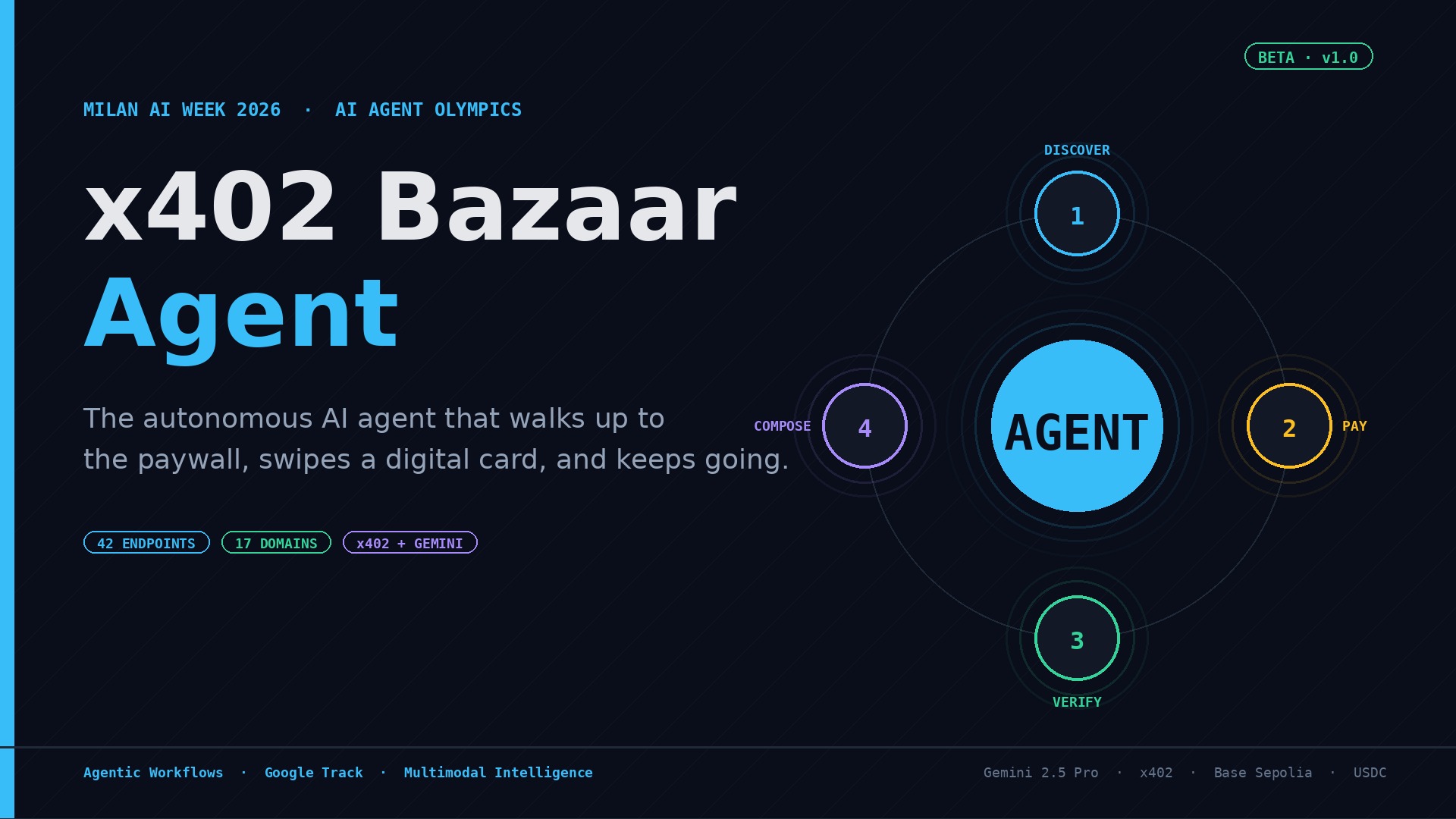
The Coinbase Developer Platform (CDP) maintains an x402 Bazaar. This is your primary source for finding cataloged, x402-enabled services. The Bazaar acts as a filtered directory where developers and AI agents can browse verified endpoints. Instead of guessing which APIs accept crypto payments, you query the Facilitator to find services that already support the x402 standard. This cuts out the noise and ensures the provider has integrated the payment flow correctly.
One notable example in this ecosystem is DeepBlue. It is an autonomous trading bot that operates on Polymarket and provides real-time crypto market data and trading signals. Their API is integrated with x402, meaning you can programmatically access their signals and pay for them in crypto without manual invoice handling. By checking the Bazaar or their official documentation, you can verify their integration status before writing a single line of code.
When evaluating providers, prioritize those with transparent integration documentation. Look for clear examples of how they handle the x402 payment request and response cycle. If a provider does not explicitly mention x402 compatibility, assume they are not ready for automated integration. Stick to the official CDP resources to ensure you are building on a stable, verified foundation.
Common integration pitfalls
Even with a solid x402 implementation, AI trading agents can stumble on specific technical hurdles. These errors typically stem from how agents handle network latency, payment failures, and asset precision.
Latency and retry logic
Trading signals are time-sensitive. If your agent doesn't account for blockchain confirmation times, it may act on stale data. Implement exponential backoff for retry logic to prevent flooding the network during congestion.
Failed payment retries
Agents often lack robust error handling for failed transactions. If a payment fails, the agent should pause and log the error rather than looping indefinitely. Use the CDP documentation to implement proper transaction status checks.
Incorrect stablecoin handling
Precision errors are common when dealing with stablecoins. Always use fixed-point arithmetic for amounts to avoid rounding errors that can lead to underpayments or rejected trades. Verify the decimal places for the specific stablecoin (e.g., USDC vs. DAI) before executing.
No comments yet. Be the first to share your thoughts!