Why x402 fits agent commerce
Traditional API key models rely on subscription gateways and manual authentication, creating friction for autonomous systems. AI agents operating in high-frequency trading environments require a payment layer that matches their speed and autonomy. The HTTP 402 status code, repurposed via the x402 protocol, offers a native internet standard for machine-to-machine commerce.
Unlike legacy systems that require complex OAuth flows or static keys, x402 allows agents to negotiate and pay for data on the fly. This is critical for trading signals, where latency and reliability are paramount. The protocol is designed specifically for transactions involving autonomous AI agents, integrating pre-payment risk checks to prevent fraud without human intervention.
x402 is not just a payment gateway; it is an internet-native protocol that allows autonomous agents to pay for data without human intervention.
This architecture shifts the burden from the developer managing subscriptions to the protocol enforcing payment. By embedding payment requirements directly into the HTTP response, x402 ensures that only paying agents receive the trading data. This creates a secure, transparent economy for AI-driven financial services.
How the payment flow works
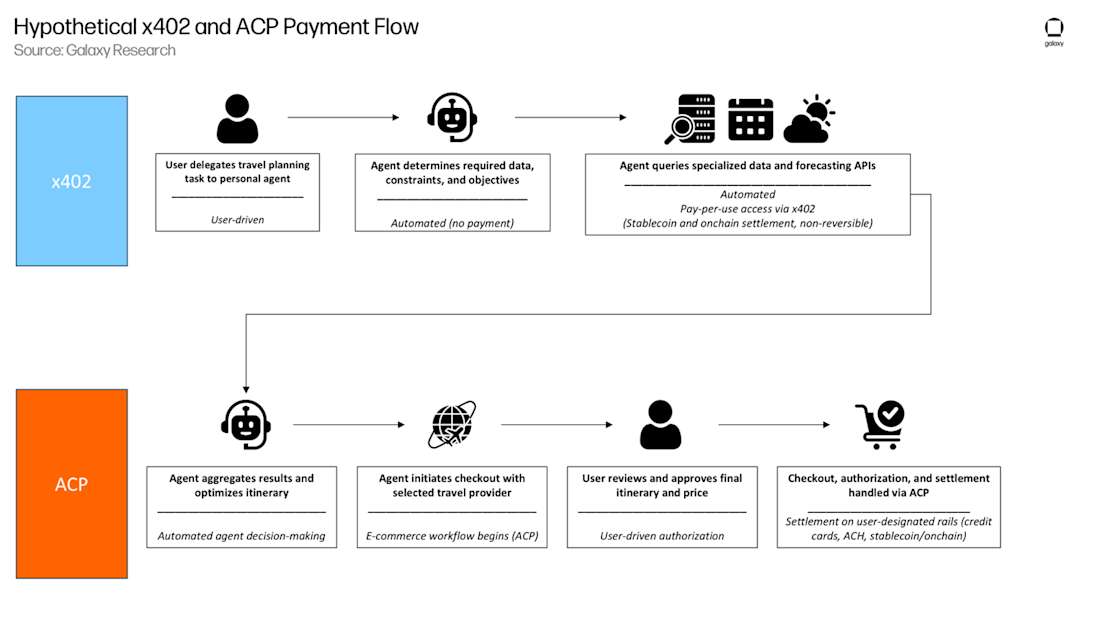
The x402 protocol turns the HTTP 402 status code into a functional payment gateway. When an AI agent requests a trading signal, the server evaluates the request against its pricing rules. If the agent hasn't paid, the server doesn't return data. Instead, it sends a 402 Payment Required response containing a structured payment payload.
This payload acts as a bill. It specifies the exact asset (typically a stablecoin like USDC), the amount, the recipient wallet address, and the blockchain network. The client—whether a human user or an autonomous AI agent—must construct a transaction matching these parameters and broadcast it on-chain.
1. Server returns 402 with payment request
The process begins when your API endpoint detects an unpaid request. Rather than returning a standard 200 OK or 401 Unauthorized, the server responds with 402 Payment Required. This response includes a JSON body detailing the payment instructions. This is where the "bill" is generated. The server defines the cost, the currency (e.g., USDC on Solana), and the destination wallet. The client receives this payload and must parse it to understand what is owed.
2. Client constructs and signs the transaction
The client, acting as the payer, takes the payment request from the server. It constructs a blockchain transaction that sends the exact amount of stablecoin to the specified wallet address. This step requires the client to have the necessary funds and the cryptographic keys to sign the transaction. For AI agents, this happens autonomously: the agent checks its balance, prepares the transfer, and signs it using its private key. This ensures the payment is valid and irreversible once confirmed.
3. Transaction is broadcast on Solana
Once the transaction is signed, the client broadcasts it to the Solana network. Solana is chosen for its high throughput and low fees, which are critical for microtransactions common in AI data feeds. The transaction enters the mempool and is picked up by validators. This step is purely mechanical: the client sends the signed blob to the network, and waits for confirmation. The speed of this step determines how quickly the AI agent can access the data.
4. Server verifies and unlocks the signal
The server monitors the blockchain for the incoming transaction. It doesn't need to wait for a single confirmation; it listens for the transaction hash referenced in the payment payload. Once the transaction is confirmed on-chain, the server verifies that the correct amount of stablecoin arrived in the designated wallet. Upon verification, the server unlocks the trading signal data and returns it to the client in a 200 OK response. The payment is complete, and the data flows.
Check the server response for the 402 Payment Required status code and the embedded payment payload. Parse the JSON to extract the asset, amount, and wallet address.
Build the transaction object using the details from the server. Ensure the asset matches (e.g., USDC) and the recipient address is correct. Sign the transaction with your private key.
Broadcast the signed transaction to the Solana network. Wait for the transaction to be included in a block and confirmed by validators.
Monitor for confirmation. Once verified, the server unlocks the data. Your client should then parse the returned trading signal and proceed with analysis.
This flow creates a trustless, automated commerce layer. No human intervention is needed to release the data. The blockchain serves as the source of truth for payment completion, allowing AI agents to purchase high-value trading signals in real-time without manual invoicing or credit checks.
| Feature | x402 Protocol | Traditional API |
|---|---|---|
| Payment Trigger | HTTP 402 Status Code | Pre-paid subscription or credit card on file |
| Settlement | On-chain stablecoin transfer | Off-chain bank transfer or processor |
| Automation | Fully autonomous for AI agents | Requires manual renewal or webhook |
| Trust Model | Trustless (blockchain verified) | Trusted third-party processor |
Solana Infrastructure Requirements
Integrating x402 endpoints for high-frequency AI trading signals demands a blockchain infrastructure that can handle micro-transactions without eroding profit margins. Solana provides this foundation through its combination of sub-second finality and negligible transaction fees. For an agent executing thousands of signal checks per minute, these characteristics are not merely convenient; they are operational necessities.
The x402 protocol leverages Solana’s speed to enable autonomous, machine-to-machine commerce. When an AI agent queries a trading endpoint, the HTTP 402 status code triggers an immediate on-chain settlement. Solana’s high throughput ensures that this verification happens in milliseconds, allowing the agent to receive the data and act on it before market conditions shift. This latency reduction is critical for strategies where the value of a signal decays rapidly.
Fee structures on Solana further support this model. Traditional blockchain networks often charge fees that exceed the value of small data transactions, making micro-payments for AI signals economically unviable. Solana’s fees remain consistently low, allowing traders to monetize granular data points—such as individual order book snapshots or sentiment scores—without requiring minimum transaction thresholds. This enables a more precise, usage-based pricing model for API access.
To contextualize the network environment in which these transactions occur, it is useful to monitor the underlying asset’s stability and volume.
The stability of settlement currency is equally important. While Solana processes the transactions, the economic value is often anchored to stablecoins like USDC. Monitoring the USDC price ensures that the agent’s revenue remains predictable and is not subject to the volatility inherent in other crypto assets.
By combining Solana’s technical capabilities with the x402 protocol, developers can build trading signal networks that are both scalable and economically efficient. This infrastructure supports the high-volume, low-latency demands of modern algorithmic trading.
Building the trading signal endpoint
To secure your proprietary data, wrap your existing trading logic with x402 compliance. The core mechanism is simple: your API returns a 402 Payment Required status when a client lacks payment credentials. The client then uses an AI agent or wallet to send a transaction, attaching the payment proof in the Authorization header. Once validated, your endpoint serves the high-value signal.
Start by implementing the standard response code in your server logic. If the Authorization header is missing or invalid, return 402 with a Pay-Url header pointing to the payment destination. This tells the requesting agent exactly where to send the funds. When the client retries with the correct header containing the transaction hash and proof, your server verifies the on-chain confirmation before delivering the data.
For implementation, refer to the official Coinbase Developer Platform quickstart for sellers. It provides the reference code for handling the payment verification flow and managing the state transitions between unpaid and paid requests. This ensures your endpoint remains stateless and secure against replay attacks.
This approach turns your API into a self-sustaining revenue stream. By automating the payment gatekeeping, you allow AI agents to purchase signals without human intervention, creating a scalable model for monetizing your trading insights.
x402 vs. traditional billing for AI agents
Integrating x402 endpoints shifts the friction point from human checkout flows to machine-to-machine negotiation. While traditional gateways like Stripe require complex setup, customer support overhead, and manual reconciliation, x402 allows AI agents to pay for API calls autonomously using stablecoins. This eliminates the need for human intervention, credit card verification, or subscription management for micro-transactions.
The primary advantage lies in autonomy. Traditional billing models struggle with the latency and volume of AI trading signals, often requiring pre-funded wallets or complex API key management. x402 embeds payment directly into the HTTP response (status 402), enabling seamless, real-time settlement without maintaining persistent user sessions or handling chargebacks. This is critical for high-frequency trading where milliseconds matter and manual approval is impossible.
| Feature | x402 Protocol | Stripe / Traditional API |
|---|---|---|
| Payment Method | Blockchain (Stablecoins/Crypto) | Credit Cards, Bank Transfers |
| Agent Autonomy | Fully autonomous (machine-to-machine) | Requires human setup/verification |
| Settlement Speed | Near-instant (blockchain confirmations) | 1-3 business days (banking rails) |
| Friction | Low (embedded in HTTP 402) | High (checkout flows, fraud checks) |
| Chargebacks | Immutable (on-chain) | High risk (disputes/chargebacks) |
Comparing these options reveals that x402 is not just a payment processor but a structural upgrade for agentic commerce. By removing the human bottleneck, AI agents can trade, analyze, and execute strategies with a level of speed and precision that traditional billing infrastructure simply cannot support.
Common questions about x402
What is x402 in AI?
x402 is an open, internet-native payment protocol built on the HTTP 402 status code. Developed by the Coinbase Development Platform team, it allows any API or web service to require payment before serving content. This makes it ideal for AI agents that need to autonomously purchase trading signals or data feeds without human intervention.
What is the difference between MPP and x402?
The main difference is payment flexibility. x402 is blockchain-native, supporting only on-chain transactions. In contrast, the Multi-Party Payment (MPP) standard is payment-method agnostic, supporting stablecoins via Tempo, credit cards via Stripe, and Bitcoin via Lightning. MPP allows a single API to accept both Visa and USDC through the same protocol, whereas x402 is strictly for blockchain-based commerce.
What is x402 on Solana?
On Solana, x402 serves as a neutral standard for internet-native payments. It addresses the "original sin" of the internet by natively enabling payments between clients and servers. This creates a win-win economy that empowers agentic payments at scale, allowing AI agents to transact securely using Solana's high-speed, low-cost infrastructure.
No comments yet. Be the first to share your thoughts!